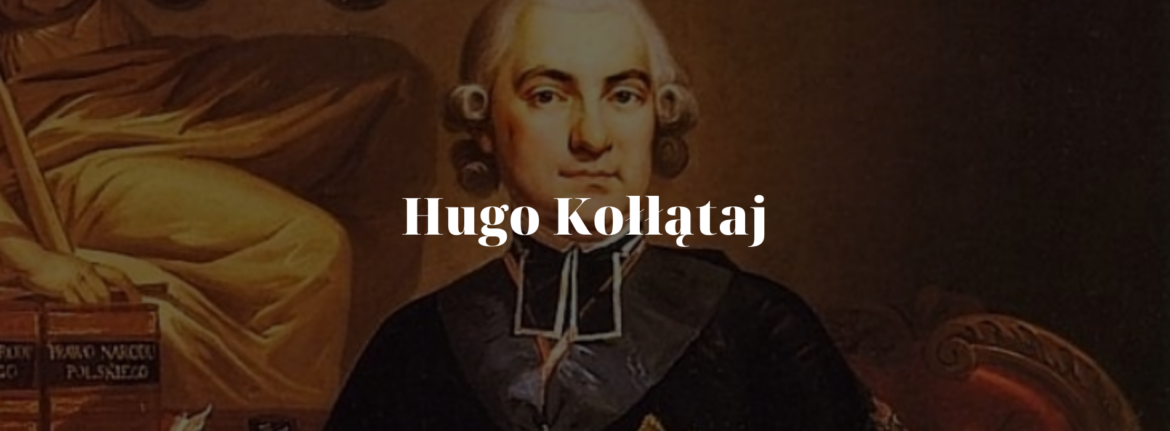
During the late 18th century, the Polish-Lithuanian Commonwealth was a sprawling but politically paralyzed state, teetering on the edge of collapse under the pressure of its powerful neighbors. It was in this atmosphere of existential crisis that Hugo Kołłątaj—a Catholic priest, philosopher, and fierce political pragmatist—emerged as the intellectual engine of the Polish Enlightenment.
Kołłątaj understood that saving the state required more than military defense; it demanded a fundamental rewiring of the nation’s mind and laws. His approach was systemic, targeting the two pillars that shape a society: how it educates its youth and how it governs its people.
Architect of Modern Education
Kołłątaj believed that a flawed political system was the direct result of an outdated, dogma-driven education. He became a driving force within the Commission of National Education (Komisja Edukacji Narodowej), which is widely recognized as the world’s first national ministry of education.
His most profound educational triumph was the radical modernization of the Kraków Academy (today the Jagiellonian University). When he took charge of reforming the institution in the late 1770s, he systematically dismantled centuries of medieval scholasticism. His methodology for academic reform was practical and unyielding:
- Language shift: He replaced Latin with Polish as the primary language of instruction, making complex ideas accessible and standardizing the national language.
- Scientific focus: He prioritized empirical sciences, introducing physics, mathematics, chemistry, and modern medical training over theoretical theology.
- Social mobility: He pushed to open the university’s doors to burghers (townspeople) and students from non-noble backgrounds, recognizing that intellectual talent was not tied to aristocratic birth.
The Radical Forge
Beyond the university walls, Kołłątaj was a master of political strategy and public opinion. He established a network of progressive writers, journalists, and thinkers in Warsaw, famously known as Kuźnica Kołłątajowska (Kołłątaj’s Forge).
Functioning much like a modern political think tank, the „Forge” relentlessly published pamphlets and articles advocating for deep systemic change. Kołłątaj used this platform to break the monopoly of the conservative nobility, arguing that the true wealth and strength of a nation lay in the freedom and prosperity of all its social classes, not just the aristocracy.
Drafting the May 3rd Constitution
Kołłątaj’s political theories culminated in the halls of the Great Sejm. Working closely with King Stanisław August Poniatowski and Ignacy Potocki, he became one of the principal authors of the Constitution of May 3, 1791. This document stands as Europe’s first modern, codified national constitution, and the second in the world after the United States.
Kołłątaj’s philosophical fingerprints are visible throughout the document, which was designed to shock the failing Commonwealth back into life. The constitution enacted sweeping reforms aligned with Enlightenment ideals:
- Ending political paralysis: It abolished the disastrous liberum veto, the rule that allowed a single dissenting noble to veto any law and dissolve the parliament.
- Separation of powers: It introduced a modern, tripartite division of government into the legislative, executive, and judicial branches.
- Social expansion: It extended legal protections to the peasantry and formally granted political and property rights to townspeople, fundamentally altering the rigid class structure.
Although the Constitution was ultimately overthrown by foreign invasions, Kołłątaj’s vision survived the subsequent partitions of Poland. He had successfully planted the seeds of a modern civic identity, ensuring that when Poland eventually reappeared on the map, it would be as a nation built on constitutional thought and progressive education.