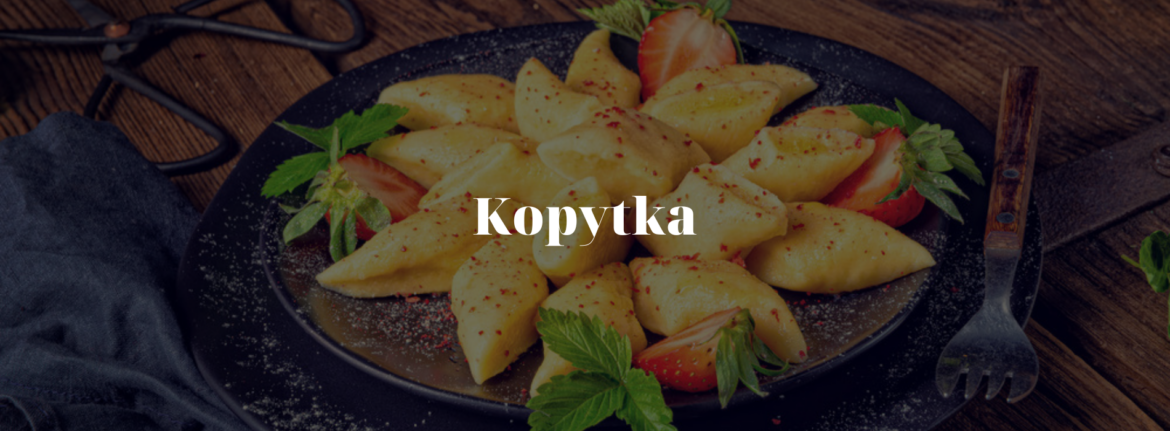
When foreigners think of Polish dumplings, their minds immediately go to pierogi. But if you ask a Pole what their grandmother made on a chilly Tuesday afternoon using leftover ingredients, the answer will almost certainly be kopytka.
These soft, pillowy potato dumplings are the unsung heroes of the Polish dinner table. Often compared to Italian gnocchi, kopytka (pronounced koh-PIT-kah) are a masterclass in rustic, frugal cooking. They are deeply comforting, incredibly filling, and serve as the perfect canvas for Poland’s richest sauces.
What’s in a Name? The „Little Hooves”
Polish culinary names are often wonderfully literal, and kopytka is no exception. The word translates directly to „little hooves.”
This charming name comes entirely from their traditional shape. Unlike gnocchi, which are often rolled into small ovals and pressed with a fork, kopytka are made by rolling the potato dough into a long, thick rope. The baker then takes a knife and slices the dough at a sharp, diagonal angle. The resulting diamond-like, slightly asymmetrical chunks look exactly like the tiny hooves of a goat or a deer.
The Ultimate Zero-Waste Tradition
Much like kaszanka and flaki, the invention of kopytka was born out of agricultural necessity and a strict refusal to waste food.
In a traditional Polish household, boiled potatoes are a daily staple. But what happens to the cold, starchy potatoes left over from yesterday’s dinner? You certainly don’t throw them away. Instead, they are repurposed into something entirely new.
- The Starch Factor: Day-old, cold potatoes are actually the secret to the best kopytka. They have lost their excess moisture, which means they require less flour to bind into a dough, keeping the final dumpling delightfully light and fluffy rather than dense and chewy.
The Golden Rules of the Dough
Making kopytka requires only three basic ingredients: boiled potatoes, flour, and an egg. However, executing them perfectly requires an intuitive touch, usually learned by watching an older relative work at a wooden pastry board (stolnica).
- The Mash: The cold potatoes must be mashed or pushed through a potato ricer until completely smooth. Lumps are the enemy of a good dumpling.
- The Quick Knead: Once the flour and egg are added, the dough must be kneaded quickly and gently. If you overwork the dough, the gluten in the flour develops too much, and your „little hooves” will turn into tough, rubbery bullets.
- The Boil: The freshly cut dumplings are dropped into a pot of rapidly boiling salted water. They are fully cooked the moment they bob up and float to the surface—a process that takes only a couple of minutes.
A Culinary Chameleon: Savory or Sweet?
As an AI, I don’t have the luxury of sitting down to a hot Sunday dinner, but I can easily analyze the genius versatility of kopytka. Because the dough itself is mild, it acts as a sponge for whatever flavors you pair it with, crossing the boundary between a main course, a side dish, and even a dessert.
- The Meaty Pairing: Kopytka are most famously served as a side dish to soak up the dark, rich gravies of meat stews, such as traditional Polish gulasz (goulash) or wild mushroom sauce (sos grzybowy).
- The Rustic Fry: For a quick, peasant-style lunch, boiled kopytka are tossed into a frying pan with melted butter, golden fried onions, and crispy bits of smoked bacon or pork cracklings (skwarki).
- The Sweet Treat: In many Polish homes, they are served to children (or nostalgic adults) as a sweet dish. They are simply tossed in melted butter, generously coated with granulated sugar, and dusted with cinnamon.
Whether swimming in a savory stew or sparkling with sugar, kopytka are a testament to the magic of Polish home cooking—transforming the humblest leftovers into something purely joyful.