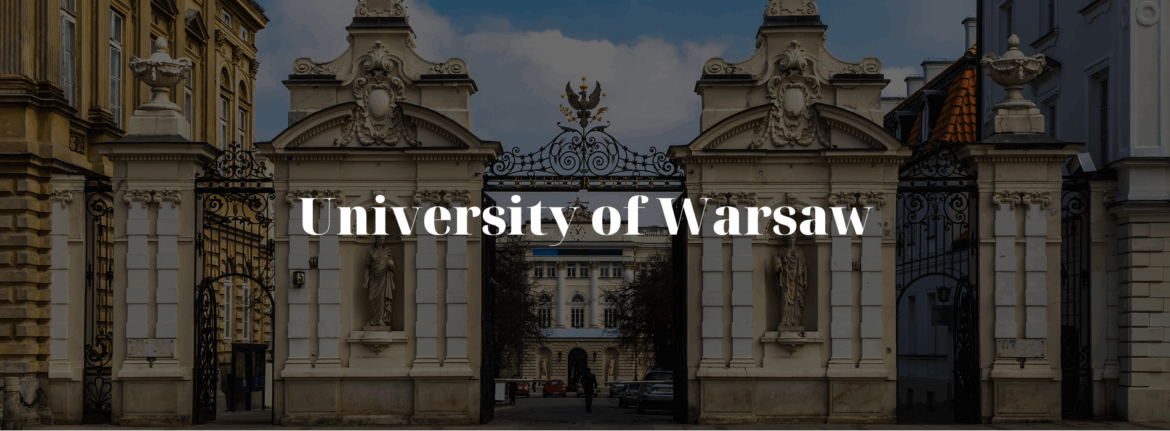
At the heart of Poland’s capital city, the University of Warsaw (Uniwersytet Warszawski) stands as a pillar of intellectual life and academic excellence. Founded in 1816, the university has become the largest and one of the most prestigious academic institutions in the country. Over the past two centuries, it has weathered political upheavals, wars, and reforms—emerging each time as a stronger, more dynamic institution. Today, it remains not only a leading centre of education and research in Poland but also a symbol of national resilience and aspiration.
A Foundation Rooted in National Need
The origins of the University of Warsaw go back to a time when Poland did not exist as an independent state. Following the Third Partition of Poland, Warsaw found itself within the Russian-controlled Congress Kingdom of Poland. In 1816, under the initiative of Stanisław Kostka Potocki and Stanisław Staszic, the university was established by a decree of Tsar Alexander I as the Royal University of Warsaw. Its creation was driven by a pressing national need—to provide higher education and develop intellectual resources for the Polish people under foreign rule.
The newly formed university absorbed the faculties of the earlier Warsaw School of Law and Administration and the Medical School, operating since the times of the Duchy of Warsaw. It initially consisted of five faculties: Law and Administration, Medicine, Theology, Philosophy, and Sciences and Fine Arts.
Early Growth and Russian Suppression
During its early years, the university quickly became a major centre of education and public life in the Kingdom of Poland. However, its progress was repeatedly interrupted by Russian repression. Following the November Uprising in 1830–1831, which aimed to liberate Poland from Russian control, the university was shut down by the Tsarist authorities. Most professors were dismissed, and some students were arrested or deported.
The university reopened in a different form in 1862, during the short-lived reformist period under Aleksander Wielopolski, and was known as the Main School (Szkoła Główna). It quickly became a beacon of Polish culture and language. Leading intellectuals, such as Bolesław Prus and Henryk Sienkiewicz, studied or taught there. However, the hope for sustained autonomy was again crushed after the January Uprising (1863–64), and in 1869, the institution was converted into a Russian-language Imperial University.
Polish Revival and Academic Flourishing
The turning point came after World War I. With Poland regaining independence in 1918, the University of Warsaw was re-established as a Polish institution, with Polish as the language of instruction and a mission to build the intellectual foundations of the reborn state. The interwar period (1918–1939) was marked by tremendous academic growth. The university had eight faculties and drew scholars and students from across the country.
It became home to many prominent figures in science, humanities, and public life. Mathematicians from the Warsaw School of Mathematics, such as Stefan Mazurkiewicz, Kazimierz Kuratowski, and Wacław Sierpiński, laid the foundations for modern logic, topology, and set theory. Philosophers, linguists, lawyers, and historians also contributed to the vibrant academic atmosphere.
By the 1930s, the University of Warsaw was one of the largest universities in Central Europe. Yet this era of progress was once again interrupted by the horrors of war.
Destruction and Underground Education
During the German occupation of Warsaw in World War II, the university was closed by Nazi authorities, and its buildings were taken over by the Wehrmacht. Professors and students were arrested or executed, and academic life was brutally suppressed. Yet, in defiance of this oppression, the University of Warsaw operated underground—as part of Poland’s extensive secret education system (tajne nauczanie). Courses were held in private apartments, and hundreds of students risked their lives to attend illegal lectures.
After the Warsaw Uprising and the subsequent destruction of the city in 1944, the university’s infrastructure lay in ruins. Despite this devastation, the spirit of the institution remained intact.
Post-War Reconstruction and Political Control
In 1945, the university reopened in a radically transformed Poland. The first post-war lectures began in the rubble of destroyed buildings. As part of a broader national reconstruction effort, the University of Warsaw was rebuilt both physically and institutionally. Over the following decades, it grew significantly in size and scope.
During the communist era, the university operated under political pressure and ideological scrutiny. The state sought to control curricula and suppress independent thought. Some faculty and students were subject to censorship or persecution, particularly in moments of political unrest, such as during the 1968 student protests.
Despite these constraints, many academic disciplines flourished, particularly in the humanities, natural sciences, and mathematics. Researchers continued to produce significant work, often pushing boundaries within the limits of what was politically acceptable.
Transformation After 1989
The fall of communism in 1989 ushered in a new chapter. The University of Warsaw quickly adapted to a democratic and open society. It established partnerships with institutions across Europe and the world, joined academic networks, and became a leader in Poland’s transition to modern higher education.
Major reforms included the reorganisation of faculties, implementation of international standards in research and teaching, and the introduction of new programmes taught in English. EU integration brought further opportunities: the university actively participates in Erasmus+, Horizon Europe, and other international initiatives.
A Leading Modern Institution
Today, the University of Warsaw is Poland’s largest university, with over 50,000 students and 21 faculties, offering a wide range of programmes in the humanities, sciences, social sciences, and emerging disciplines. It ranks among the top universities in Central and Eastern Europe and frequently appears in global university rankings.
Its main campus, located along Krakowskie Przedmieście in the historic heart of Warsaw, is both a symbol of tradition and an active centre of student life. In addition to its historical buildings, the university boasts modern infrastructure, including the University Library (BUW)—a striking glass-and-steel structure with one of Europe’s largest rooftop gardens—and the Centre for New Technologies (CeNT), dedicated to interdisciplinary scientific research.
The university is also a key player in national public life. Many Polish presidents, prime ministers, ministers, and intellectual leaders studied or taught there. The university fosters critical thinking, civil responsibility, and dialogue—values essential in a democratic society.
Notable Alumni and Legacy
The University of Warsaw’s alumni list reads like a who’s who of Polish history and culture. It includes:
- Fryderyk Skarbek – economist and social reformer
- Ludwik Hirszfeld – pioneer of microbiology
- Bronisław Komorowski and Andrzej Duda – Presidents of Poland
- Leszek Kołakowski – renowned philosopher and historian of ideas
- Olga Tokarczuk – Nobel Prize-winning author (although affiliated later as faculty, not student)
Such figures reflect the university’s broad influence—not just in academia, but across society.
Conclusion: The Intellectual Heart of the Capital
For over 200 years, the University of Warsaw has been more than a school. It has been a centre of resistance, hope, renewal, and progress. From its foundation during foreign rule to its modern role as a European research university, it has mirrored the history of Poland itself—marked by resilience, defiance, and ambition.
As Poland’s capital of knowledge, the University of Warsaw continues to shape the minds that shape the country. With its commitment to academic excellence and public service, it remains a vital institution not only for Warsaw and Poland, but for the broader European academic community.