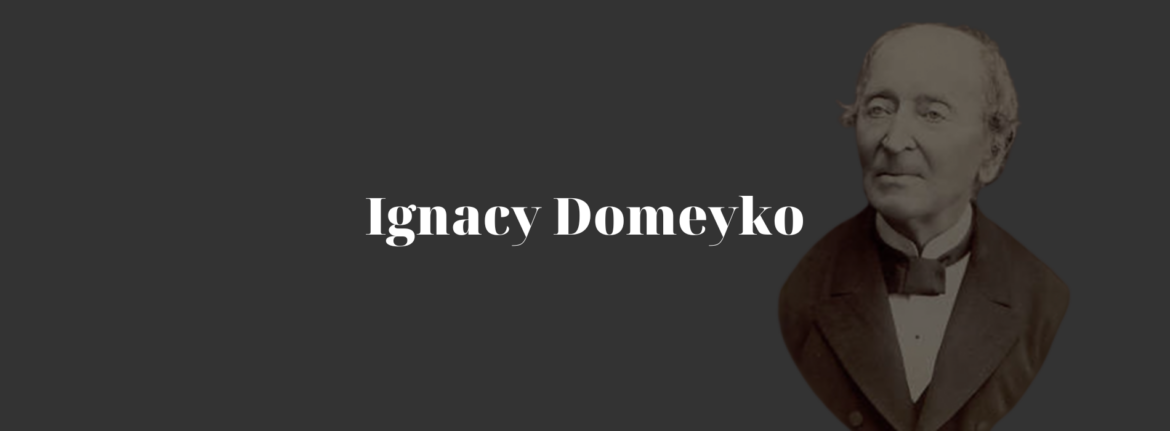
History is filled with figures who have shaped the destiny of their homelands, but it is rare to find a scholar who becomes a national hero on a completely different continent. Ignacy Domeyko, a Polish geologist, mineralogist, and educator, is one of these rare exceptions. Forced into exile by political turmoil in Europe, he crossed the Atlantic and ultimately laid the scientific and educational foundations of modern Chile.
His life is a testament to how scientific curiosity and a dedication to education can transcend borders, turning a political refugee into a towering figure of South American history.
The Journey from Exile to the Andes
Domeyko’s early life was deeply intertwined with the Polish struggle for independence. Born in 1802 in the lands of the former Polish-Lithuanian Commonwealth (modern-day Belarus), he was a close friend of the legendary Polish poet Adam Mickiewicz and a member of the secret Philomath society at Vilnius University. Following his participation in the failed November Uprising against the Russian Empire in 1830, Domeyko was forced to flee to France.
In Paris, he redirected his intense intellectual energy from political resistance to the sciences, graduating from the prestigious École des Mines (School of Mines). In 1838, an unexpected opportunity arose: he was offered a contract by the Chilean government to teach mineralogy and chemistry in the mining town of Coquimbo. What was originally intended to be a temporary, six-year stay turned into a lifelong dedication to his adopted nation.
Mapping the Wealth of the Earth
When Domeyko arrived in Chile, the country’s vast mineral wealth was largely unexplored and poorly understood. He did not confine himself to the classroom; instead, he embarked on massive, grueling expeditions across the rugged terrain of the Andes and the Atacama Desert.
He systematically surveyed the country’s geology, mapping coal deposits, silver veins, and copper reserves that would eventually become the backbone of the Chilean economy. His relentless fieldwork brought scientific rigor to South American mining. He introduced modern assaying techniques, modernized extraction methods, and discovered multiple new mineral species. In recognition of his vast contributions to mineralogy, the copper arsenide mineral he extensively studied was later named domeykite in his honor.
Beyond geology, Domeyko also conducted vital ethnographic work. He spent time with the indigenous Mapuche people in southern Chile, studying their culture and advocating for their rights and peaceful integration, standing in stark contrast to the aggressive military campaigns of the era.
Rebuilding Chilean Education
Domeyko’s impact on Chile went far beyond rocks and minerals. He recognized that for a young nation to thrive, it needed a robust, modern educational system capable of producing its own scientists and engineers.
In 1847, he joined the faculty of the newly established University of Chile in Santiago. Serving as the university’s rector for 16 years (1867–1883), he completely restructured the country’s higher education system. Drawing on his European academic background, he shifted the university’s focus from classical and theological studies toward the empirical sciences, physics, chemistry, and mathematics.
Though he never forgot his Polish roots—maintaining correspondence with fellow exiles and visiting Europe in his twilight years—Domeyko poured his life into Chile. By the time of his death in Santiago in 1889, the exiled Polish student had become the undisputed father of Chilean science. Today, his name marks the map of the world in profound ways, from the sprawling Cordillera de Domeyko mountain range to an asteroid orbiting in space.