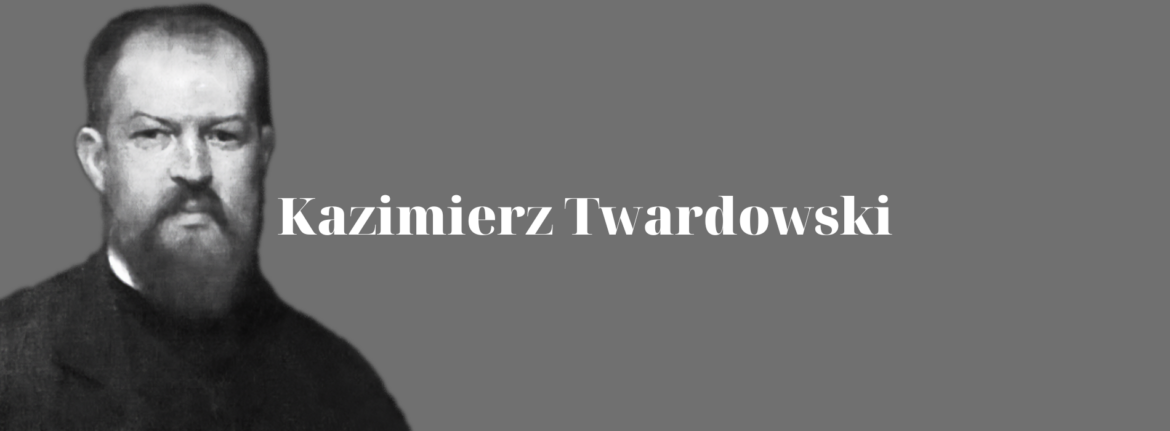
At the end of the 19th century, philosophy in partitioned Poland was largely dominated by romantic messianism and heavy, speculative poetry. It was an era where national emotion often eclipsed rigorous, analytical thought. This intellectual landscape changed permanently in 1895 when a young, fiercely brilliant philosopher named Kazimierz Twardowski arrived at the University of Lwów.
Twardowski did not bring sweeping, mystical theories. Instead, he brought a scalpel. He introduced a demand for absolute linguistic clarity, uncompromising logic, and scientific rigor, ultimately giving birth to the Lwów–Warsaw School—one of the most important philosophical and logical movements of the 20th century.
The Vienna Roots and the Tripartite Distinction
Twardowski was heavily influenced by his mentor in Vienna, the philosopher Franz Brentano, who famously argued that all mental phenomena are directed toward an object (a concept known as intentionality). Twardowski took this foundation and refined it, solving a major puzzle in the philosophy of mind and language.
In his groundbreaking 1894 work, On the Content and Object of Presentations, Twardowski established a strict, permanent boundary between three distinct elements of human thought:
- The Act: The psychological process or mental action of thinking, imagining, or perceiving.
- The Content: The mental picture, meaning, or concept that exists entirely within the mind as a result of the act.
- The Object: The actual, external thing in the real world that the thought is directed toward.
Before Twardowski, philosophers frequently confused the mental concept of a thing with the thing itself. By separating the content (which is always mental) from the object (which can be physical, fictional, or non-existent, like a golden mountain), he provided a perfectly clear framework that allowed philosophers to analyze language and meaning without falling into psychological traps.
An Empire of Clarity
When Twardowski took his chair in Lwów, his methodology was revolutionary. He despised obscure, overly complicated academic jargon, famously arguing that if a philosopher cannot explain their ideas clearly, then those ideas are simply not thought out properly. „Clear speech is the reflection of clear thought,” became the unspoken motto of his classroom.
He trained his students to treat philosophy with the exact same methodological rigor as mathematics or physics. This insistence on anti-irrationalism and logical analysis birthed the Lwów–Warsaw School. It was not a physical institution, but a massive intellectual network that dominated Polish academia.
When Poland regained independence in 1918, Twardowski’s students left Lwów to establish and lead university departments in Warsaw, Kraków, and Poznań. They carried his methodology with them, fundamentally reshaping the country’s intellectual infrastructure.
The Architect of Modern Logic
While Twardowski himself focused primarily on psychology and the philosophy of language, the environment he cultivated allowed mathematical logic to flourish to an unprecedented degree.
Because he taught his students to dissect language and arguments with surgical precision, they naturally gravitated toward formal logic. The Lwów–Warsaw School produced a staggering roster of world-class minds, including:
- Jan Łukasiewicz: Who invented multi-valued logic (proving that statements don’t just have to be „true” or „false”) and the parenthesises-free Polish notation.
- Alfred Tarski: Who revolutionized semantics and the mathematical definition of truth, becoming one of the greatest logicians in human history.
- Stanisław Leśniewski: Who developed highly original, formal systems for the foundations of mathematics.
- Tadeusz Kotarbiński: Who developed „reism” and praxeology, the science of efficient action.
The Master of Teachers
Twardowski’s ultimate legacy lies not in a single book, but in his people. He was, above all else, a masterful educator and a community builder. He established the Polish Philosophical Society, founded the leading philosophical journal Ruch Filozoficzny, and organized laboratories for experimental psychology.
He viewed teaching as a deep moral responsibility, guiding his students not just academically, but ethically. By insisting that philosophy must be clear, rational, and completely devoid of nationalistic or romantic delusions, Kazimierz Twardowski built an intellectual powerhouse that would go on to shape global analytic philosophy, linguistics, and computer science for decades to come.