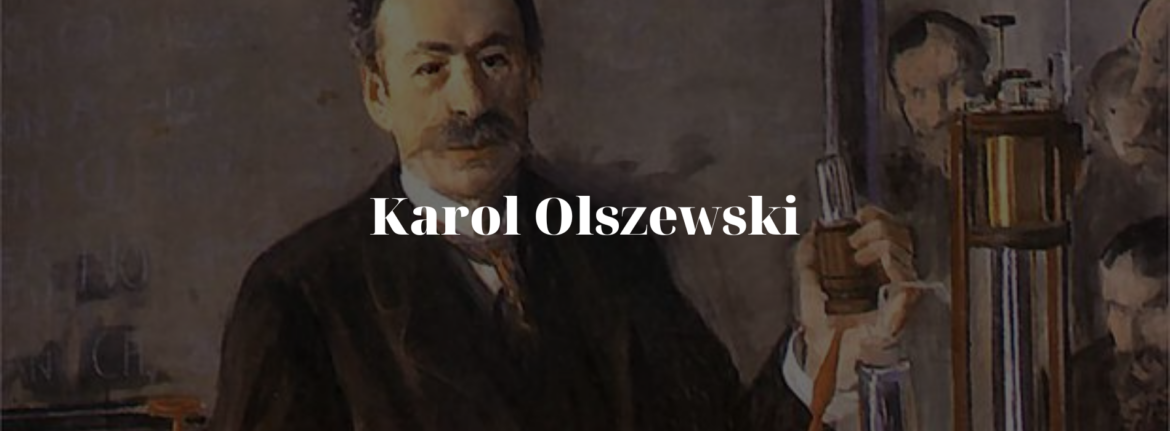
During the late 19th century, physicists across Europe were engaged in a fierce, international race to achieve what many thought was impossible: turning the air we breathe into a liquid. At the time, leading scientific minds believed that certain gases were fundamentally „permanent” and could never change their physical state. It took the brilliant experimental methodology of Polish chemist and physicist Karol Olszewski, working alongside his colleague Zygmunt Wróblewski, to shatter this assumption and give birth to the modern field of cryogenics.
Their work at the Jagiellonian University in Kraków didn’t just break records; it fundamentally expanded humanity’s understanding of thermodynamics and the extreme limits of matter.
The Myth of the „Permanent Gases”
For decades, scientists had tried to liquefy atmospheric gases like oxygen and nitrogen by applying immense physical pressure. However, they repeatedly failed because they did not fully account for a critical thermodynamic principle: every gas has a specific „critical temperature.” If a gas remains above this temperature, no amount of applied pressure will ever force it to condense into a liquid.
To liquefy the so-called permanent gases, the primary challenge was no longer about engineering stronger pressure valves—it was about achieving unprecedented, mind-numbing cold.
The Cascade Breakthrough of 1883
Olszewski and Wróblewski were the perfect scientific match. Wróblewski brought theoretical insights regarding critical temperatures from his travels across European laboratories, while Olszewski was a master of chemical engineering, capable of designing and blowing intricate glass apparatuses that could withstand extreme thermal shock and pressure.
To reach the necessary temperatures, Olszewski engineered a highly complex „cascade method” of cooling. The methodology relied on using one liquefied gas to cool another in a stepped sequence. By boiling liquid ethylene under a strict vacuum, they forced the chemical to absorb massive amounts of heat from its surroundings, dropping the temperature of the internal chamber to an astonishing -130°C.
On April 9, 1883, their precise methodology paid off: they succeeded where the rest of the scientific world had failed, producing the first stable, observable quantity of liquid oxygen. They noted its beautiful, pale blue color and its strong magnetic properties. Just days later, on April 13, they successfully liquefied nitrogen.
Pushing Toward Absolute Zero
Following the tragic death of Wróblewski in a laboratory fire in 1888, Olszewski continued his intense cryogenic research alone. He continually refined his cooling apparatus, making his laboratory in Kraków the undisputed global epicenter for low-temperature physics.
When British scientists Sir William Ramsay and Lord Rayleigh discovered the mysterious noble gas argon, they knew exactly who to turn to. They sent a sample directly to Olszewski, who successfully liquefied and then solidified the new element, accurately determining its boiling and freezing points. Olszewski continued to break his own records, eventually reaching temperatures as low as -225°C in his attempts to liquefy hydrogen. Through his relentless experimentation, he pushed human capability ever closer to the theoretical absolute zero, laying the essential groundwork for modern cryosurgery, space exploration, and superconductivity.